

Hook
If you removed your company’s name from your accounting policies, could they be used as is in another company’s financial statements?
Users of financial statements rely on accounting policies to understand how a company applies the relevant accounting framework (for example, the IFRS® Accounting Standards) to its business. Yet many preparers still provide policies that are high-level, vague or generic1. As such, they offer no real insight. In addition, unclear policies undermine trust and reduce the usefulness of the financial statements.
1This includes boilerplate descriptions copied from templates of financial statements and policies that simply repeat accounting terminology without explaining the company’s own circumstances and judgements applied.
Fog Zone: a fictional vague lease accounting policy
This fictional scenario reflects a common generic lease accounting policy seen in practice.
Leases
When a contractual arrangement contains a lease, the Group recognises a lease liability and a corresponding right of use asset at the commencement of the lease.
At the commencement date the lease liability is measured at the present value of the future lease payments, discounted using the Group’s incremental borrowing rate where the interest rate in the lease is not readily determined. Subsequently, the lease liability is adjusted by increasing the carrying amount to reflect interest on the lease liability, reducing the carrying amount to reflect the lease payments made and remeasuring the carrying amount to reflect any reassessment or lease modifications.
The lease term is determined from the commencement date of the lease and covers the non-cancellable term. If the Group has an extension option, which it considers it is reasonably certain to exercise, then the lease term will be considered to extend beyond that non-cancellable period. If the Group has a termination option, which it considers it is reasonably certain to exercise, then the lease term will be considered to be until the point the termination option will take effect.
At the commencement date the right of use asset is measured at an amount equal to the lease liability plus any lease payments made before the commencement date and any initial direct costs, less any lease incentive payments. An estimate of costs to be incurred in restoring an asset, in accordance with the terms of the lease, is also included in the right of use asset at initial recognition. Subsequently, the right of use asset is depreciated over the life of the lease term.
An adjustment is also made to the right of use asset to reflect any remeasurement of the corresponding lease liability. The right of use assets are also subject to impairment testing under IAS 36. Short-term leases and low value leases are not recognised as lease liabilities and right of use assets but are recognised as an expense straight line over the lease term.
Lookout Observation
The Financial Reporting Council (FRC) and the Johannesburg Stock Exchange (JSE) continue to focus on the quality of accounting policy disclosures. Their comments reinforce the requirements of IAS 1 – Presentation of Financial Statements, which require entities to disclose material accounting policy information. It discourages generic accounting policies.
Lease accounting policies are a common example. Many companies summarise the accounting requirements for leases but provide little insight into the company’s lease arrangements, significant judgements and accounting choices. As a result, users learn more about the accounting standard than they do about the business.
BhalaGood North Star Award: Marshalls plc
The BhalaGood North Star Award recognises individual disclosures that provide practical examples for other preparers of financial statements.
The disclosure below is the lease accounting policy (page 131) in Marshalls plc’s consolidated annual financial statements for the year ended 31 December 2025.
We have recognised this disclosure because it presents a concise, entity-specific lease accounting policy that avoids repeating the requirements of IFRS 16 – Leases. It clearly identities the types of assets subject to a lease, explains the lease terms and describes its approach to low-value assets.
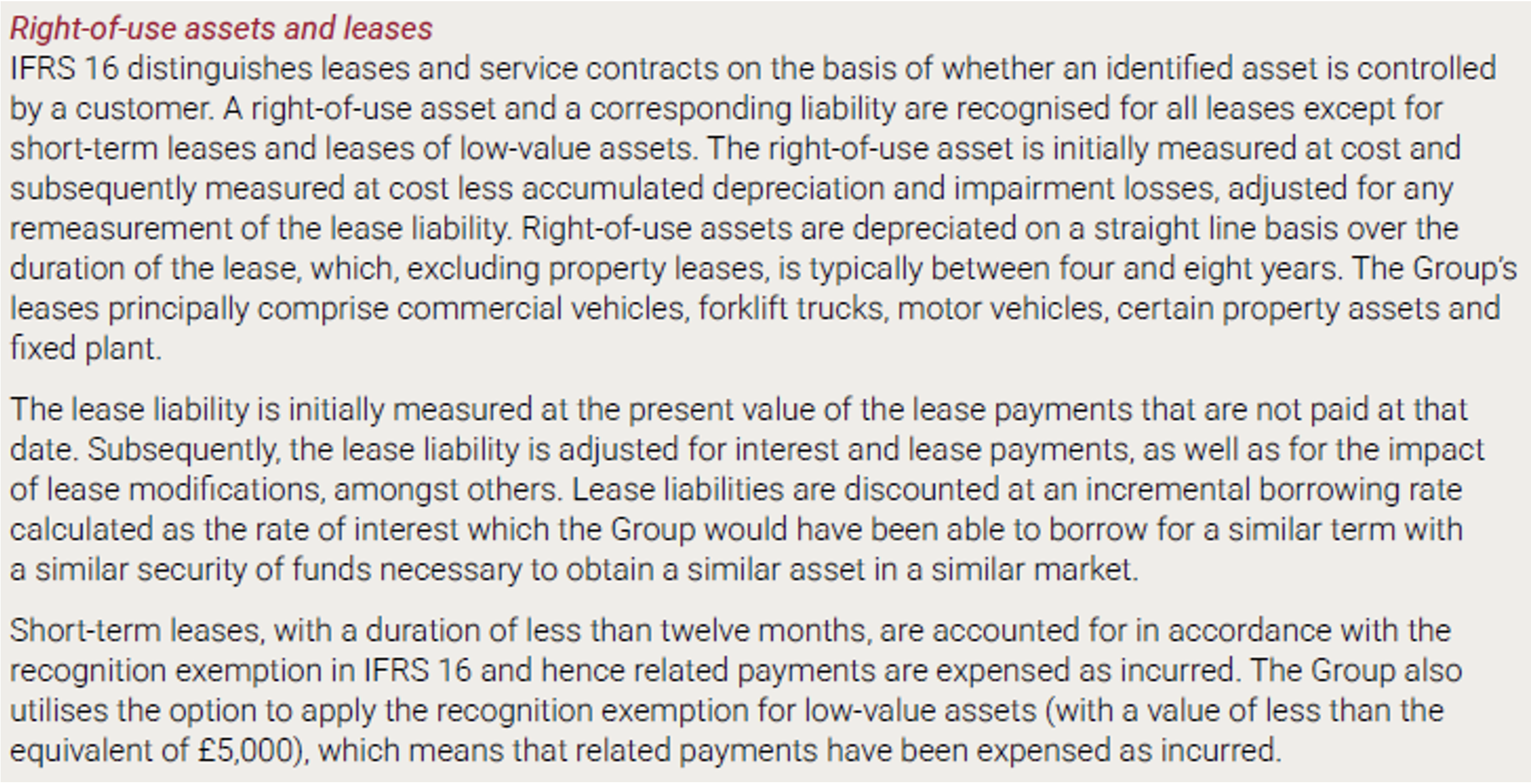
Source: https://www.marshalls.co.uk/investor/results-reports-and-presentations
Smooth Sailing Tip
Clear accounting policies are not necessarily long accounting policies. They are entity-specific, commercially grounded and convey judgements that were applied.
To enhance accounting policies, companies should:
- avoid boilerplate wording; and
- explain how they applied the requirements of the IFRS Accounting Standards, rather than simply repeating what those requirements are.
If a policy could be taken from an accounting standard or a textbook, it is almost certainly too generic.
Here is a simple approach:
If the policy does not help a user understand how the numbers were produced, refine it until it does.
Glynnis Carthy CA(SA)
Independent expert support to improve clarity, quality and compliance under IFRS® Accounting Standards
The inclusion of a disclosure in this article should not be interpreted as an opinion on its compliance with IFRS Accounting Standards or on the financial statements as a whole.